其他資訊 Other information
一. 學生來源
本學程主要針對全球的國際生,特別是新南向政策國家,包括但不限於東南亞和南亞地區,如越南、印尼、泰國、馬來西亞及印度等,招收具醫護、醫事技術、生醫等相關學系之畢業生,並同時吸引國際醫療機構、學術機構以及政府機構的在職人士就讀。這些國家多面臨新興醫療科技及健康照護體系的快速發展與對應的人才需求挑戰,特別是在醫學科技應用及數位健康領域方面的需求尤為迫切。本學程將提供應用醫學科技於全球健康問題解決能力、跨學科知識與國際視野的課程,對有志於提升醫學科技專業能力並拓展國際經驗的學生具相當的吸引力。
二. 招生名額規劃
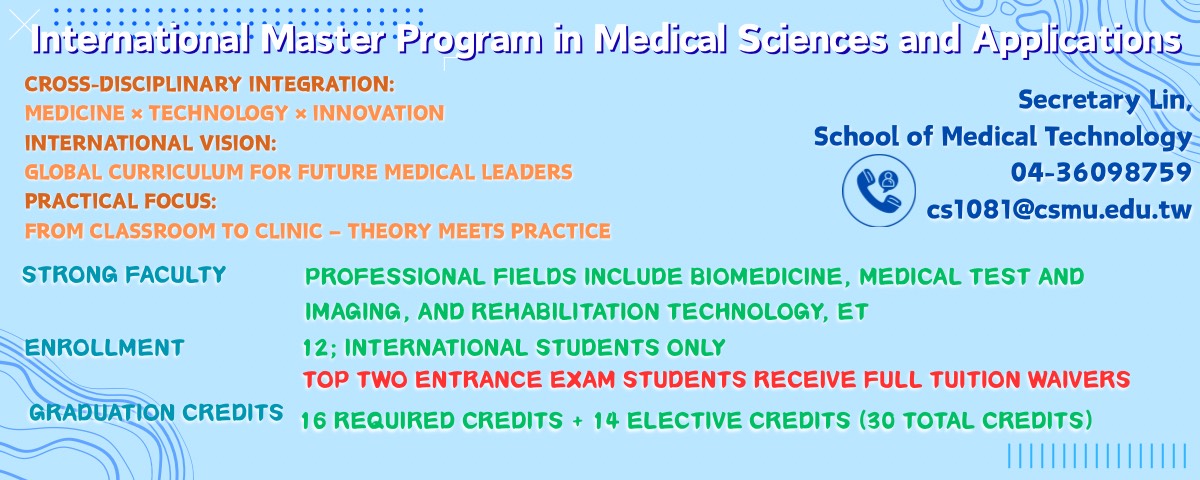
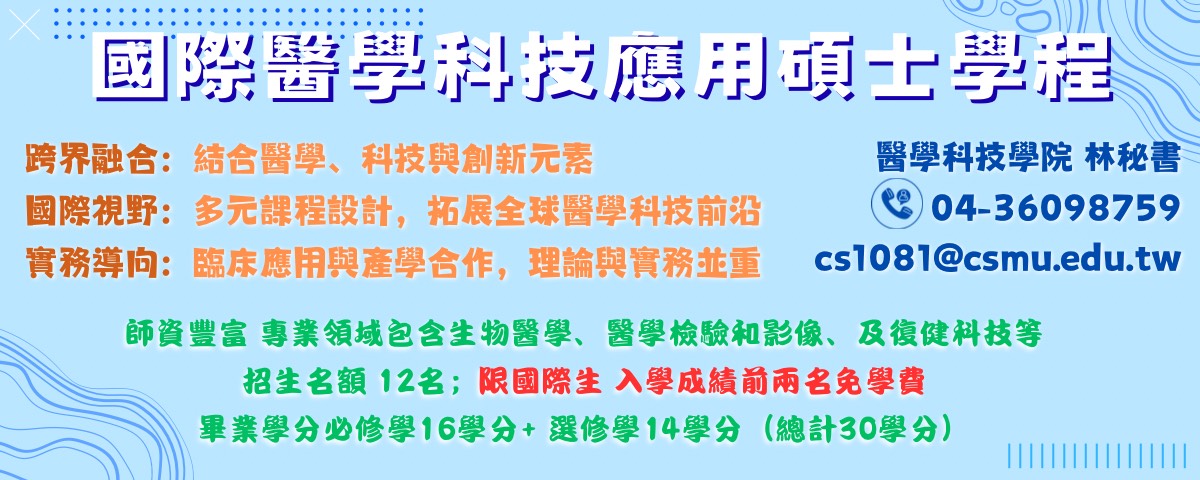
本學程預計每年招收12名國際學生,這些學生將來自新南向政策國家,以及其他有醫學科技應用人才需求的國家。招生名額的設置已考慮到師資規模、教學資源及國際合作的需求,確保每位學生都能獲得充分的學習支持及實習機會。
三. 他校相同或相近系所招生情形
目前台灣各大專校院的醫學科技應用相關國際碩士學位學程仍相對有限,包括(1)國立台灣大學的國際生醫工程學程(International Graduate Program in Biomedical Engineering, NTU-iBME),碩士班10-15人/年;(2)國立陽明交通大學的生物醫學資訊與人工智慧國際碩士學位學程(International Master Program in Biomedical Informatics and Artificial Intelligence, BMI & AI) 10-15人/年;(3)國立成功大學的國際奈米醫學與工程學位學程(International Graduate Program of Nanomedicine and Engineering, IGPNME),碩士班10-15人/年;(4)台北醫學大學的國際生醫材料與組織工程學程(International Ph.D. Program in Biomedical Materials and Tissue Engineering)與醫學科技暨健康資訊國際碩士學位學程(International Master’s Program in Medical Science and Health Informatics),10-15人/年;(5) 中國醫藥大學的國際生物醫學碩士學位學程(The International Master’s Program of Biomedical Sciences),10-15人/年。因此,本學程的設立將有助於填補醫學科技應用領域中為滿足的需求,並藉由提供專業化、特色化與國際化的學習環境來吸引更多國際學生及來自新南向政策國家的學生。
四.其他學程優勢條件之說明
- 具備特色研究方向 精準醫學、精準檢驗以及人工智慧與大數據分析是醫學科技應用的主要方向,隨著醫學科技發展的日新月異,其應用領域不斷地擴大,同時也需要許多其他領域研究的跨域整合。也因為醫學科技的應用範圍巨大,許多創新創意的初步概念多在前驅試驗階段,臨床實證仍有待時間累績更多的研究成果與數據分析。本學程聚焦三大醫學科技應用的研究主軸:精準醫學檢驗與大數據分析、再生醫學與細胞治療、以及免疫治療與基因編輯應用,規劃相關特色課程與整合學程教師群的研究主題,可使學生能專注於有興趣的研究主軸,學習到充分的基礎科學知識,同時可以規劃與進行相關的醫學科技應用研究主題。搭配本校豐富的臨床研究資源,可更有效率的提升研究成果的臨床應用潛力。
- 具備健全的研究資源及師資結構 本學程以特色研究目標導向,具有跨院際完整的師資結構,並與校級研究中心及校外學研機構緊密合作,不僅可以提升各項醫學科技應用之研究量能,同時也增加實質研究合作之機會。
- 整合臨床資源與應用導向研究 以疾病或臨床議題為導向之跨領域研究教學群,提升基礎及臨床研究的整合與連結,提高研究成果之應用潛力。以科技應用導向式的研究,可激發學生對研究主題之創新性應用發想,並透過研究設計與規劃來驗證與產生具可行性的醫學科技應用創意。
- 國際性研究與教學 課程採全英語授課,與最新的國際研究成果接軌,並掌握最新的國際醫學科技應用發展,提升學生的研究視野、科技應用創意、以及國際競爭力。
I. Source of students
This course is mainly aimed at international students around the world, especially in countries with new southbound policies, including but not limited to Southeast Asia and South Asia, such as Vietnam, Indonesia, Thailand, Malaysia and India, etc., and recruits graduates from related departments such as medical care, medical technology, biomedicine, etc., and at the same time attracts international medical institutions, academic institutions and In-service personnel of government agencies are studying. Most of these countries are facing the rapid development of emerging medical technology and health care systems and the challenge of the corresponding demand for talents, especially in the field of medical science and technology application and digital health. This course will provide courses on applying medical technology to global health problem-solving ability, interdisciplinary knowledge and international vision, which is quite attractive to students who aspire to improve their professional ability in medical science and technology and expand their international experience.
II. Enrollment quota planning
This program is expected to enroll 12 international students every year. These students will come from countries with the New Southward policy and other countries with the need for medical science and technology application talents. The establishment of the enrollment quota has taken into account the needs of teachers, teaching resources and international cooperation to ensure that every student can get full learning support and internship opportunities.
III. The enrollment situation of the same or similar departments in other schools
At present, the international master's degree programs related to the application of medical science and technology in major colleges and universities in Taiwan are still relatively limited, including (1) the International Graduate Program in Biomedical En Gineering, NTU-iBME), Master's Class 10-15 people/year; (2) International Master Program in Biomedical Information and Artificial Intelligence of National Yangming Jiaotong University Medical Informatics and Artificial Intelligence, BMI & AI) 10-15 people/year; (3) International Nanomedicine and Engineering Degree Program of National Chenggong University (Internat Ional Graduate Program of Nanomedicine and Engineering, IGPNME), Master's Class 10-15 people/year; (4) Taipei Medical University's International Medical Materials and Tissue Engineering Course ( International Ph.D. Program in Biomedical Materials and Tissue Engineering) and International Master's Pro in Medical Technology and Health Information Gram in Medical Science and Health Informatics), 10-15 people/year; (5) International Biomedical Master's Degree Program of China Medical University (The International M Aster's Program of Biomedical Sciences), 10-15 people/year. Therefore, the establishment of this course will help meet the needs in the field of medical science and technology application, and attract more international students and students from the new southward policy countries by providing a professional, distinctive and international learning environment.
IV. Explanation of the advantages of other courses
With distinctive research directions, precision medicine, precision testing, artificial intelligence and big data analysis are the main directions of medical science and technology application. With the rapid development of medical science and technology, its application fields are constantly expanding, and it also requires cross-domain integration of research in many other fields. It is also because of the huge scope of application of medical science and technology, many preliminary concepts of innovative ideas are mostly in the precursor trial stage, and clinical empirical evidence still needs more research results and data analysis. This course focuses on the research main axes of the application of medical science and technology: precision medical testing and big data analysis, regenerative medicine and cell therapy, and immunotherapy and gene editing applications, planning relevant special courses and integrating the research topics of the course teacher group, so that students can focus on the research axis of interest and fully learn Basic scientific knowledge, and at the same time, relevant medical science and technology applied research topics can be planned and carried out. With the rich clinical research resources of the school, the clinical application potential of the research results can be improved more efficiently.
With sound research resources and teacher structure, this course is guided by characteristic research goals, has a complete cross-institutional faculty structure, and closely cooperates with school-level research centers and off-campus research institutions, which can not only improve the research capacity of various medical science and technology applications, but also increase the opportunities for substantive research cooperation.
Integrate clinical resources and application-oriented research. A cross-field research and teaching group oriented by disease or clinical issues, improve the integration and linkage of basic and clinical research, and improve the application potential of research results. With scientific and technological application-oriented research, it can stimulate students to think of innovative applications of research themes, and verify and generate feasible medical science and technology application ideas through research design and planning.
International research and teaching courses are taught in full English, in line with the latest international research results, and master the latest international medical science and technology application development, so as to improve students' research horizons, scientific and technological application creativity, and international competitiveness.